Before the Planner Page: A Short History of the Weekly Calendar
The history of the weekly calendar traces how a seven-day cycle moved from religious and civic timekeeping to printed almanacs, diaries and planners.
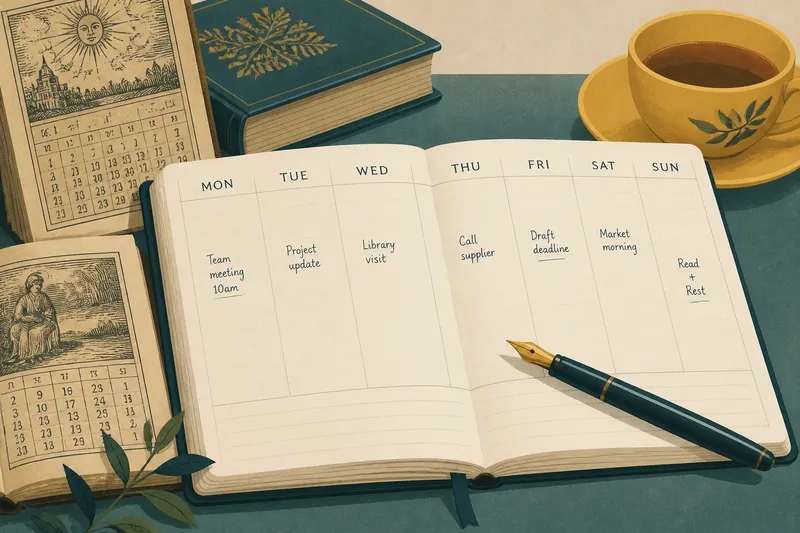
A paper calendar sits open beside a cup of tea, its seven columns turning a run of days into something the eye can hold. The history of the weekly calendar starts well before that familiar page: with a repeating cycle, then with printed formats that made dates easier to consult and, eventually, easier to annotate.
There is no single inventor or moment when the weekly planner appeared. Its story runs through distinct stages: the spread of the seven-day week, the growth of printed calendars and almanacs, and the later use of dedicated pages for appointments and personal notes. Keeping those stages separate makes the history clearer than treating today’s planner as an ancient form.
The seven-day cycle
The seven-day week is older than the printed planner, but it is not a simple division of a lunar month. Its history is bound up with religious practice and civic convention; in the Roman world, the seven-day week became increasingly established in the centuries before and during the early Christian era. The cycle continued to organise days independently of the changing lengths of months.
That distinction shaped what calendars had to show. A date belongs to a particular month and year, while a weekday belongs to a repeating sequence. A calendar page brings the two together, placing numbered dates under weekday names.
Long before a household could buy a paper planner, communities used calendars for different purposes. Religious observances, seasonal markers and civic dates all needed their own forms of record. These practices supplied recurring structures; they were not yet the same thing as a modern weekly diary with room for appointments.
Almanacs in print
With the spread of European printing, almanacs became a familiar way to consult dates alongside other practical material. Their pages might combine calendars with information such as feast days, seasonal guidance or tables. The date was part of a larger reference work, not necessarily a blank space waiting for a reader’s plans.
Printed calendars gradually served more settings, including offices and homes. Their layout had to help a reader locate a date quickly, so a monthly grid became useful: rows and columns showed how dates fell across weekdays. The grid offered an overview, though it left limited room for writing beside any one day.
That limitation helps explain the appeal of a dedicated weekly view, but it does not establish a single origin for the weekly planner. Formats developed for different uses, and a dated reference calendar should not be confused with a diary designed to record a person’s schedule.
From dates to appointments
As diaries and appointment books became common printed tools, the calendar page acquired a second job. It could still locate a date, but it could also hold a note about what would happen on that day. Lines, boxes and open spaces turned the page into a surface for planning as well as reference.
A weekly spread gave several adjacent days room on one page or across facing pages. Compared with a monthly grid, it made individual entries easier to write and read; compared with a daily diary, it kept a shorter run of days in view. The shift was not a neat replacement of one format by another. Different layouts continued to suit different purposes.
Imagine a village reading room choosing between a wall calendar and a weekly diary for its notice desk. The wall calendar would let visitors find a date in the month at a glance; a weekly diary would give the organiser room to write a meeting beside its day. The choice changes the page’s emphasis, not the underlying seven-day cycle.
Layouts on paper
Once a week became a unit for recording plans, designers had to decide how its days should occupy the page. These are common choices, not a fixed historical sequence:
- Vertical columns: Days run down the page, often with neighbouring days side by side. This makes comparison easy, though a narrow column can constrain handwriting.
- Horizontal rows: Days run across the page or appear in separate bands. The sequence reads from left to right, while the available writing area depends on the page’s proportions.
- Boxed grids: Each day has a clear boundary. The boxes separate entries, but can make days feel like individual compartments.
- Continuous spreads: A broad area holds the week with few dividers. The open surface offers flexibility, but clear day labels are needed to keep entries in place.
The week’s starting day also changes how a page reads. A Monday-first layout places the usual working sequence at the front; a Sunday-first layout puts Sunday before Monday. Neither arrangement changes the calendar dates, but each reflects a convention familiar to its intended readers.
Weekend treatment adds another signal. Saturday and Sunday may have separate spaces, share a smaller area or receive different visual emphasis. Those decisions show how a calendar’s makers expected readers to distinguish workdays, rest days and other recurring commitments.
Questions about weekly calendars?
Why did weekly calendars become popular?
A weekly view keeps a short, recurring stretch of days together and offers more room for entries than a monthly grid. It became useful as printed calendars and diaries served readers who wanted both to find dates and to record plans.
Why do some calendars start on Monday?
Monday-first layouts follow conventions that treat Monday as the opening of the working week. Sunday-first layouts remain familiar in other settings, so publishers choose an arrangement that suits their readers.
Why is Sunday sometimes given more space?
A larger Sunday area can reflect religious or social significance, or a design choice that separates the weekend from weekdays. It also makes Sunday more visually prominent before anyone writes on the page.
How does a weekly view differ from a monthly one?
A monthly grid shows how dates relate across a whole month, while a weekly view gives each day more room and keeps neighbouring days together. The first favours broad date-finding; the second favours recording and scanning a particular week.
The page as a record
Printed appointment calendars, diaries and planners all used dated pages, but invited different kinds of marks. Some provided ruled lines for entries; others relied on open boxes or a separate notes area. The extra writing space did not erase the calendar’s reference function: it added a place to record what a date meant to its owner.
Paper size, binding and page direction also shaped the experience. A spread that opens flat can keep several days visible, while a compact page may favour a quick glance over longer notes. Like a row of coat hooks, the weekday positions stay put while dates and commitments come and go.
Digital calendars can switch between views, but a printed planner commits to its chosen arrangement. That fixed design is part of its history: the printed page made a particular interpretation of the week visible and repeatable.
The history of the weekly calendar is therefore a sequence of changing uses, not a straight march towards one perfect layout. When you open a paper weekly calendar, notice where the week begins, how it treats the weekend and whether the spaces invite notes or simply help you locate dates; those choices show what kind of record the page was made to support.