Notebook, Wall Calendar or Desk Pad: Pick by Where You Look
Choose a notebook, wall calendar or desk pad by where you naturally look, so your weekly plan is easy to consult and fits your everyday routine.

You reach for the kettle, glance at the fridge and remember the appointment you meant to write down. Choosing a notebook, wall calendar or desk pad is easier when you start with that ordinary moment: where would you look for the date, and what would you need to do with the page?
Each format gives paper a different home. A notebook closes and travels, a wall calendar stays on display, and a desk pad lies open beside your work. Think of them like a coat, a noticeboard and a worktop: each keeps useful things accessible in a different way.
Start with the setting
Notice where you tend to make planning decisions. You might check dates while packing a bag, while passing through the kitchen, or after sitting down at a particular desk. Choose a format that belongs naturally in that setting, rather than one that depends on a new reminder habit.
Next, consider how you use the page. Do you need to jot a private note, let another person see an event, or leave a sheet open while working through a list? The answer points towards a format and its trade-offs before you need to think about paper colour or binding.
Notebook access
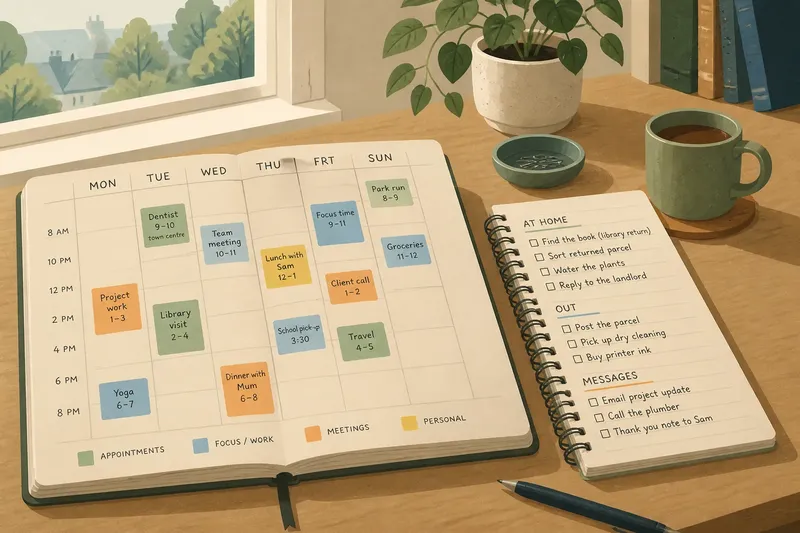
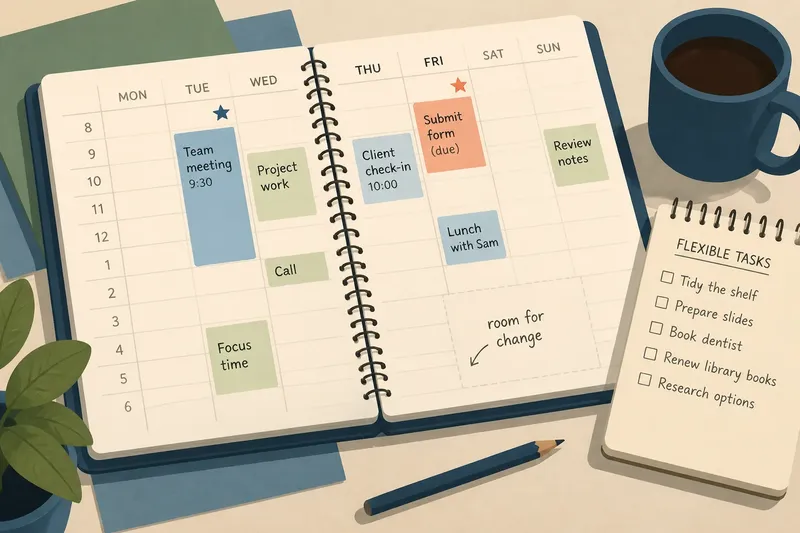
A notebook suits plans that need to travel with you or sit alongside private notes. A weekly spread can hold dates, a short list and preparation details together. A dated diary labels the days for you; an undated notebook lets you begin where you like but asks you to write in the dates.
Its closed cover keeps the page out of view, so a notebook is less useful as a passing reminder. It also works best when you can reliably bring it along or keep it near the place where you plan. A ribbon or page marker can help you reopen the current spread, but cannot make the book visible if it is tucked away.
Wall calendar access
A wall calendar makes dates visible to people who share a home, studio or office. Put it on an open wall along a route people already take, such as near the coat hooks or beside a desk. Shared events can be read without someone having to find and open a book.
The calendar stays put, and its date boxes may not have room for long notes. A wall behind a door, or a page hidden by other papers, offers little practical visibility. If details change while you are away, use the wall calendar for dates others need to see and keep any extra context in a separate place.
Desk pad access
A desk pad gives you an open writing surface at the place where you work. It can keep dates and working notes on the same sheet, ready for a quick mark or a crossed-out task. Unlike a notebook, it does not need opening; unlike a wall calendar, it is close at hand for writing.
That convenience depends on a clear patch of desk. Papers, equipment or a shared workspace can hide the current page, and a pad is awkward to carry from room to room. Decide where used pages will go if you need to keep a record of them.
Format choices
Compare each format against a real point in your routine. For every line below, check the observation and follow the matching decision; if the alternative describes your situation better, use that option instead.
- Check where you need dates: If you often consult them away from home, choose a notebook; if you mainly check at one fixed spot, choose a wall calendar or desk pad.
- Check who needs to see events: If other people must read the same dates, choose a wall calendar in a shared place; if the dates are private, use a notebook instead.
- Check where you write notes: If you need to work directly beside a keyboard or papers, choose a desk pad; if you need notes in several places, choose a notebook.
- Check how much detail you record: If entries need preparation notes, choose a notebook with room beside the dates; if entries are brief, a wall calendar may be enough.
- Check what you tend to overlook: If a closed book slips your mind, choose a visible wall calendar or an unobstructed desk pad; if public display is unsuitable, keep a notebook in a regular carry bag.
- Check whether the page can stay in place: If your planning surface is usually free, choose a desk pad; if the desk is shared or often cleared, choose a notebook you can put away.
- Check whether you need one shared view: If a household needs to see dates together, choose a wall calendar; if each person needs separate notes, use individual notebooks instead.
Imagine you work at a desk but share evening plans with your partner. Starting with a desk pad that holds your work notes, you could mark a household event there and write the same short date and event on a wall calendar near the coat hooks; the resulting trade-off is a useful work surface plus a shared view, with the extra task of keeping that one event in both places. If you would rather maintain only one paper tool, choose the format that answers the question you consult most often.
Common choices?
Can two formats work together?
Yes, if each has a separate purpose, such as a wall calendar for shared dates and a notebook for personal notes. Copy only the information that genuinely needs to appear in both places, or differences between pages may cause confusion.
Which format travels best?
A notebook is easiest to carry, although it helps only if it is with you when a planning decision comes up. A wall calendar stays fixed, while a desk pad is made for a work surface.
What if I forget to check my planner?
Move it to a place you already notice: an open wall on your usual route, the desk where you begin, or a bag you carry regularly. If it remains out of sight, change to a format that can stay visible at the moment you need it.
How much should I write in a date box?
Use a short phrase that identifies the event, then put longer preparation details in a notebook or on a separate sheet. If the entry becomes hard to read, move some of its information elsewhere.
Set a natural home
Once you have chosen a format, give it a place that suits its job: a notebook near your bag, a wall calendar on a clear shared route, or a desk pad where your hand can reach it. Notice whether the page is easy to retrieve, open or read in that spot; if it is not, move the tool before replacing it.
The best paper calendar for your routine is the one you can consult without searching for it. A small change of location may be all it takes to make the page useful when a date or note is needed.